


Table of Contents
- Why Anglers Are Searching for Coastal Fishing Gear Alternatives
- What to Look for in Saltwater Fishing Apparel
- Performance Fishing Shirts for Coastal Weather
- Best Saltwater Fishing Shirts and Gear for 2026
- Price-to-Value Comparison for Coastal Fishing Gear
- Layering Systems and Fit for Long Days on the Water
- Frequently Asked Questions
Last Updated: September 12, 2026
Why Anglers Are Searching for Coastal Fishing Gear Alternatives
Anglers searching for the best coastal fishing gear alternatives to Huk or AFTCO are usually chasing the same three things: sun protection that survives a full season, fabric that dries before the next cast, and a price that reflects how long the gear actually lasts. According to the American Cancer Society's skin cancer prevention guidance, UV radiation exposure accumulates over a lifetime, which is why serious saltwater anglers treat UPF-rated apparel as equipment rather than clothing. This guide from Bay Flats Apparel breaks down what separates coastal fishing gear that holds up from gear that quits by August, and which pieces are worth the money in 2026.

Here's the tension most buyers miss: the brands with the biggest marketing budgets are not always the ones built for salt. Salt spray, humidity, and constant UV exposure punish stitching, zippers, and fabric coatings in ways freshwater gear never experiences. Below, we'll show you exactly what to evaluate before you switch brands, plus a price-to-value breakdown of a coastal-specific lineup.
What to Look for in Saltwater Fishing Apparel
The best saltwater fishing shirts combine three things: certified UV protection, fast moisture movement, and hardware that resists corrosion. Miss any one of those and the shirt fails in the field, regardless of how it looks on the rack.
Ultraviolet protection factor (UPF) is the fabric equivalent of SPF. UPF 50+ blocks roughly 98% of UV radiation, while UPF 30+ blocks about 96% (cancer.org). For long days on open water, where reflected light comes off the surface from below as well as above, higher ratings matter.
Moisture-wicking and quick-drying fabric moves sweat away from skin and releases it into the air. Polyester-spandex blends dominate this category because they hold shape, stretch with casting motion, and dry fast after spray or wading.
Pro TipCheck the hardware, not just the fabric. Non-corrosive zippers and snaps matter more in saltwater than almost any other feature. A great fabric on a rusted zipper is a dead shirt by midseason.
UPF 50+ Fishing Apparel and Sun Protection
UPF 50+ fishing apparel is the baseline for coastal work, not an upgrade. Long sleeves, hoods, and thumbhole cuffs cover the neck, ears, and hands, which are the areas most anglers forget to protect.
Look for crossover collars and extended hoods that stay put in wind. A hood that flaps loose in a 15-knot breeze offers coverage on paper and nothing in practice.
Moisture-Wicking and Quick-Drying Fabrics
Breathability separates shirts you can wear from first light to last cast from shirts you peel off by 10 a.m. Vented backs, mesh linings, and underarm eyelets all increase airflow where heat builds fastest.
A common mistake is buying a heavyweight "technical" shirt for summer flats work. In high humidity, lighter fabric with real venting outperforms thicker fabric every time.
Performance Fishing Shirts for Coastal Weather
Performance fishing shirts for coastal weather need to handle three conditions in a single day: harsh morning sun, midday heat with no wind, and afternoon thunderstorms that arrive without warning. That range is why layering matters more on the coast than inland.
Quick-drying matters most right after a soaking. A shirt that stays wet holds heat, chafes, and defeats the purpose of breathability. Fast-drying synthetics and bamboo-rich blends both handle this well, though synthetics generally dry faster while bamboo blends feel cooler against skin in still air.
Best Saltwater Fishing Shirts and Gear for 2026
The best saltwater fishing shirts and gear for 2026 prioritize airflow engineering over branding. The lineup below is built around one design principle: move air, dump heat, dry fast. But rather than repeat spec sheets, this section focuses on how each piece behaves under the specific stresses of coastal fishing, salt crust, humidity, and long UV exposure.
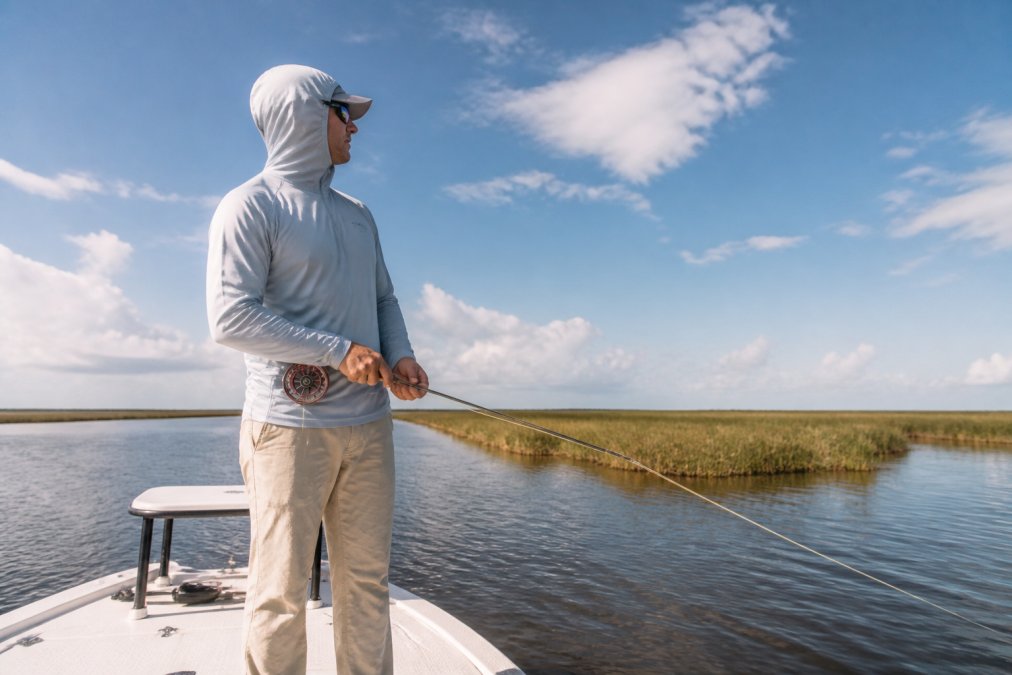
Prioritizing moisture-wicking fabrics and sun protection remains essential for long days on the water, a standard that extends naturally to our curated coastal apparel picks.
Hooded Shirts and Sun Protection
Hooded designs win for extended sun exposure because they eliminate the gap between collar and hat. The BAY FLATS Airflow Fishing Hoodie ($65) pairs a crossover collar with thumbhole cuffs, and its moisture-wicking fabric is built for breathability on the flats. A common pattern among anglers is that the crossover collar is the difference between a burned neck and an unburned one on a 6-hour flat wade, the hood stays put in a 15-knot breeze where a loose hood flaps uselessly.
For a softer feel, the BAY FLATS Bamboo Blend Fishing Hoodie ($75) uses a bamboo-rich blend rated UPF 30+ with a stay-put crossover hood. Bamboo blends tend to feel cooler against skin in still, humid air, but they dry more slowly than pure synthetics after a soaking. That trade-off matters if you're getting sprayed regularly; if you're mostly dry, the comfort advantage is real.

If you want more structure and utility, the BAY FLATS Airflow Waypoint Hooded Fishing Shirt ($95) was shaped by guide feedback. It stays buttoned, breathes, and holds its shape when conditions turn, with two breast pockets and a zippered stash pocket. The button front resists the "billowing" problem common to zip-front hoodies in crosswinds, and the stash pocket fits a small fly box or phone without sagging the chest.
Performance Pants and Outerwear
Shorts are the most common first mistake on the salt. The BAY FLATS Airflow Drifter Performance Pant ($95) exists for the angler who learned the hard way, delivering full leg coverage without the weight. The airflow fabric is designed to dump heat through the thighs, which is where most pants trap it. In practice, these pants help anglers stay comfortable as long as they're moving; standing still in direct sun, any pant will heat up.
For weather protection, the BAY FLATS Nylon Full-Zip Rain Jacket ($199) pairs a waterproof nylon shell with a mesh liner and back vents so you don't sweat through your base layer. The key mechanism here is the mesh liner: it keeps the waterproof shell off your skin, which prevents the "clammy" feeling that makes many rain jackets unbearable in coastal humidity. The back vents allow heat to escape when you're wearing a backpack or fighting a fish.
The BAY FLATS Ultra-Light Windbreaker ($100) cuts gusts on wind-blown days with water-repelling nylon and UPF 30+ coverage. It's not a rain jacket, it's for the 15-20 mph morning run when the wind cuts through a performance shirt. Pack it in a boat bag; it weighs almost nothing.
Product |
Price |
Best For |
Key Feature |
|---|---|---|---|
Airflow Fishing Hoodie |
$65 |
Everyday flats coverage |
Crossover collar, thumbholes |
Bamboo Blend Hoodie |
$75 |
Humid still-air days |
UPF 30+, bamboo-rich blend |
Airflow Waypoint Hooded Shirt |
$95 |
Guides, full-day wear |
Buttoned front, stash pocket |
Airflow Drifter Pant |
$95 |
Full leg sun protection |
Airflow fabric, fast-drying |
Nylon Full-Zip Rain Jacket |
$199 |
Storm days |
Waterproof shell, back vents |
Ultra-Light Windbreaker |
$100 |
Windy open-water runs |
Water-repelling, UPF 30+ |
Pro TipWhen evaluating any hooded shirt for saltwater, check the hood's attachment point. A hood sewn into the collar (rather than a separate piece) is less likely to tear off in wind and won't bunch under a hat.
Long-Term Wear: What to Expect After a Season
Most gear reviews stop at first impressions. A more useful question is how these pieces hold up after 50+ wash cycles and repeated salt exposure.
- Zippers and snaps are usually the first failure point. Non-corrosive hardware (plastic or coated metal) outlasts bare metal by a wide margin. Rinse after every trip.
- Fabric coatings (DWR on rain jackets and windbreakers) degrade with salt and UV. Expect to re-treat a rain jacket after a season of heavy use.
- Stitching at stress points (shoulders, hood attachment, pocket corners) is where cheap gear fails. Reinforced bar-tacks at these points are a good sign.
- Color fading is cosmetic but tells you about UV exposure. A shirt that fades unevenly may also be losing UPF effectiveness over time.
This is the difference between a shirt that lasts three seasons and one that quits by August.
Price-to-Value Comparison for Coastal Fishing Gear
Price-to-value in coastal fishing gear comes down to cost per season, not cost per item. A shirt that survives three seasons at $95 costs less per year than a shirt that fails after one at $50. But that math only works if you know what actually drives longevity in saltwater.
The Federal Trade Commission's guidance on environmental and durability marketing claims makes clear that durability claims should be substantiated, which is a useful filter when comparing brands. Ask what specifically backs a longevity promise: reinforced stitching, corrosion-resistant hardware, or just marketing language.
The Real Cost Drivers in Saltwater Gear
Three components determine whether a piece of coastal gear lasts one season or three:
- Hardware, zippers, snaps, and grommets. Non-corrosive materials (plastic, anodized aluminum, coated brass) cost more upfront but eliminate the most common failure point. A $95 shirt with a rusted zipper is a $95 loss.
- Fabric weight and weave, lighter, tighter weaves resist salt crystal abrasion better than loose knits. Heavier fabric isn't always better; it can trap salt and heat.
- Stitching and construction, reinforced bar-tacks at stress points (shoulders, hood attachment, pocket corners) add cost but prevent blowouts. Flatlock seams reduce chafing and are less prone to salt abrasion than standard overlock seams.
Price Tiers and What You Get
The Bay Flats lineup sits in the mid-range, offering better hardware, UPF 50+ options, and thoughtful ventilation. This is the sweet spot for anglers who fish frequently.

A Unique Angle: The 50-Wash Test
Most price comparisons ignore what happens after repeated washing and salt exposure. A shirt that looks great in the store may pill, fade, or lose its DWR coating after 20 washes. When comparing prices, ask:
- Does the manufacturer recommend machine washing or hand washing? (Hand-wash-only gear costs more in time.)
- Are there reports of color fading or fabric degradation after a season?
- Is the UPF rating inherent to the fabric or a topical treatment? (Inherent lasts; topical washes out.)
Spending more on the pieces that face the harshest conditions (hoodies, pants) and less on accessories can be a rational allocation of gear budget.
Watch OutJudging saltwater gear by freshwater reviews can be a mistake in this category. A shirt that performs for a season of lake fishing may fail in salt spray within weeks because corrosion and UV load are far higher on the coast.
Bottom Line on Value
The best value in coastal fishing gear is not the cheapest shirt, it's the one that lets you fish comfortably and safely for the most seasons. For most anglers, that means targeting the $75-$100 range for core pieces, prioritizing corrosion-resistant hardware and UPF 50+ where available, and rinsing gear after every saltwater trip. That routine alone can double the functional life of a shirt.
Layering Systems and Fit for Long Days on the Water
Layering systems matter more on the coast than most anglers expect, because conditions shift from brutal sun to wind-driven rain in the same trip. A workable three-layer approach looks like this:
- Base layer: a UPF-rated performance shirt or hoodie against the skin
- Mid layer: a windbreaker or light shell for temperature swings and wind
- Outer layer: a waterproof rain jacket for storms and spray
Fit is the other half of the equation. A relaxed cut allows airflow and unrestricted casting; an overly tight fit traps heat and restricts motion. For inclusivity, look for lines that carry both men's and women's cuts with tailored patterning. The BAY FLATS Ladies Short Sleeve Performance Buttondown ($85) uses princess seams for a tailored torso fit, mesh-lined vents, and a zippered chest pocket, so women aren't stuck sizing down in men's gear.
For shoulder-season versatility, the BAY FLATS Men's Long Sleeve Airflow Pearl Snap Shirt ($95) and the short-sleeve BAY FLATS Airflow Blitz Pearl Snap Shirt ($85) both carry UPF 30+ protection and stretch that moves with casting motion rather than against it.
Frequently Asked Questions
What features should I look for in saltwater-specific fishing shirts?
Prioritize UPF 30+ or 50+ sun protection, moisture-wicking and quick-drying fabric, and breathability through vented backs or mesh panels. Look for antimicrobial treatments to manage odor during long days, flatlock seams to prevent chafing, and corrosion-resistant hardware that won't rust from salt spray. A hooded sun shirt with thumbholes adds coverage for your neck and hands. Saltwater-resistant materials and stain-release technology help gear hold up season after season.
How does Bay Flats Apparel compare to mainstream fishing brands?
Bay Flats Apparel focuses specifically on coastal saltwater environments rather than general outdoor use. Their Airflow fabric is engineered to move air and dump heat, with UPF 30+ protection and quick-drying properties. Many pieces are tested by fishing guides. Prices range from $65 for the Airflow Fishing Hoodie to $199 for the Nylon Full-Zip Rain Jacket, positioning them as a premium option built for durability in salt and sun.
Is UPF 50+ fishing apparel necessary for coastal fishing?
UPF 50+ blocks 98% of UV radiation, which matters when you're on the water where sun reflects off the surface. Long-sleeve shirts with UPF 30+ or higher reduce sunburn risk and let you skip constant sunscreen reapplication. For wade fishing or fly fishing where you're exposed for hours, UPF-rated performance fishing shirts for coastal weather are more practical than short sleeves and sunscreen alone.
What are the best saltwater fishing shirts for hot, humid conditions?
Look for lightweight, breathable fabrics with moisture-wicking and quick-drying properties. Hooded sun shirts with vented backs and mesh lining keep air moving while blocking UV rays. Polyester-spandex blends offer stretch and durability without clinging. Options like the BAY FLATS Airflow Waypoint Hooded Fishing Shirt ($95) are designed for extreme heat, with buttoned fronts and zippered stash pockets for utility. Avoid heavy cotton, which holds sweat and dries slowly.


